
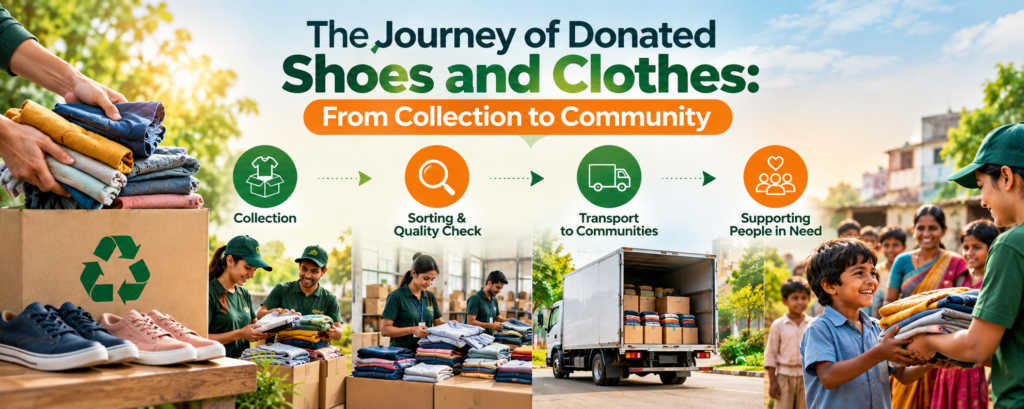
When a pair of shoes or a bag of clothes is donated, its journey does not end at the collection point. The material enters a structured system where it can be sorted, assessed and directed towards reuse or upcycling.
For an organisation working across collection, upcycling and community programmes, each stage has a specific purpose. Greensole Foundation connects the collection of discarded footwear and apparel with material processing, product development and community distribution.
What Happens After Donated Items Are Collected?
Once footwear and apparel reach the collection system, they need to be handled according to their type and condition. Different materials have different possibilities for reuse, refurbishment or upcycling.
Greensole collects discarded footwear and apparel through corporate partners, educational institutions, residential societies, retail collection points and other collection initiatives. The collected material is then moved into the next stage of the process.
This is where a donation changes from an individual contribution into part of a larger material recovery system.
Recording and Organising Collected Materials
Managing large quantities of donated material requires more than simply gathering items in one place. Greensole’s model includes logging and tracking collected footwear and textile waste through data management.
This helps create a record of the material entering the system and supports better organisation as it moves through different stages.
Collection data can also help organisations understand where materials are coming from and how collection networks can be expanded. Corporate partners, schools, residential communities and other groups can therefore become part of a wider system rather than operating as isolated collection points.
Sorting Materials According to Their Potential
After collection, materials are sorted and assessed. Footwear, clothing and other textile materials may require different forms of handling, so separating them is an important part of the process.
Each item is considered according to factors such as its condition, material and potential application. Suitable footwear can move towards refurbishment, while textile materials may be directed towards other upcycling applications.
Sorting also helps prevent unsuitable material from moving further into the processing system. It creates a clearer route for materials that can be recovered and used.
From Collected Material to Upcycled Products
The next stage focuses on converting suitable discarded materials into products with another practical use.
Greensole’s upcycling model includes refurbishing discarded footwear into comfortable slippers. Industrial textile waste can also be converted into products such as school bags and mats.
The transformation requires people, equipment and careful handling. Depending on the material and product, different activities may be involved in preparing, assembling and finishing the materials.
Upcycling therefore involves more than changing the appearance of an old product. It involves assessing what material is available and determining how it can be incorporated into another useful application.
The People Behind the Processing
The journey of donated material is also connected with livelihood creation. Greensole’s programmes include training and employment opportunities for local workers, with a focus on creating opportunities for women.
Its skill development initiatives support people in learning aspects of the refurbishment process and operating the equipment involved.
This adds another dimension to the collection and upcycling model. The system does not only focus on where discarded materials go. It also involves people who handle, process and prepare those materials for their next use.
Quality, Safety and Hygiene
An upcycled product must be suitable for its intended application before it reaches a community. This makes quality and hygiene important parts of the processing stage.
Greensole’s production activities include hygiene and safety protocols along with quality standards. These measures help ensure that finished products are appropriately prepared before distribution.
Quality checks also show why the processing stage cannot be treated as a simple transfer of old materials into new products. Each stage contributes to the final condition of the product.
Identifying Where Products Are Needed
Once products are prepared, the next question is where they should be distributed.
Greensole works with local partners, education departments and CSR sponsors during its community programmes. Beneficiary identification and need assessment help connect available products with relevant communities.
Its donation programmes have included government and low-income schools, orphanages, child shelters and rural and tribal communities.
This stage creates a connection between two different parts of the initiative. Materials that were collected as discarded footwear or textile waste can eventually be directed towards programmes addressing practical needs in communities.
Community Distribution and Local Coordination
Distribution is carried out through organised donation drives rather than simply sending finished products without a defined programme.
Local coordination can involve community partners, schools, education authorities and other organisations involved in the programme. Community engagement and documentation also support the distribution process.
For example, school-based programmes can help identify where footwear, bags or mats are required and coordinate their distribution to the intended beneficiaries.
The process therefore continues even after the product has been completed. Delivery, coordination and documentation form part of the wider journey.
How Corporate and Institutional Partners Fit Into the Journey
The collection system can grow when different groups contribute at different stages. Companies can organise collection drives, schools can facilitate collection among students and residential communities can bring together footwear and apparel from multiple households.
Corporate partnerships can also support broader programmes through CSR initiatives. These partnerships can connect collection activities with upcycling and community-focused programmes.
Such participation is particularly relevant when larger quantities of material need to be collected and managed through an organised system. A structured collection network allows contributions from different locations to enter the same broader process.
From One Donation to a Larger Cycle
The journey of a donated item can involve several stages before it reaches its next user. Collection brings the material into the system. Sorting determines its potential, processing prepares it for another application, and quality checks help ensure that the finished product is suitable for use.
The final stage connects the product with a community programme.
This creates a link between material recovery and social programmes. A discarded pair of footwear is no longer considered only as waste. Depending on its condition and material, it can become part of a refurbishment or upcycling process.
Why the Complete Journey Matters
Looking at the complete journey helps explain why organised collection and upcycling systems are important. The value of such an initiative does not come from collection alone.
It depends on what happens afterwards.
Materials need to be managed, processed and converted into suitable products. People need to be involved in the work. Finished products need to meet quality requirements, and community programmes need to identify where they can be useful.
Greensole Foundation brings these stages together through a model that combines footwear and textile collection, upcycling, livelihood opportunities and community distribution.
Conclusion
The journey of donated shoes and clothes continues long after they leave the original owner’s home. Collection is only the entry point into a larger process involving tracking, sorting, material assessment, upcycling, quality checks and community distribution.
Through its collection and upcycling activities, Greensole Foundation connects discarded footwear and textile materials with practical product applications. Its programmes also involve local workers, corporate partners, educational institutions, communities and organisations supporting distribution.
Understanding this journey gives a clearer picture of what happens to suitable donated materials after collection. Instead of viewing donation as a single transaction, it can be understood as the first stage of a structured system that moves materials from collection towards reuse, upcycling and community programmes.