
Shoe waste is an important part of the wider conversation around responsible consumption and resource management. Every year, footwear reaches the end of its useful life for different reasons. Some pairs are worn out, others are no longer needed, and many simply remain unused in homes, offices and storage spaces.
Instead of treating every unwanted pair as waste, shoe upcycling provides another option. Suitable footwear can be collected, assessed and processed to create useful products while supporting wider environmental and social initiatives.
However, making shoe upcycling effective requires participation from different groups. Individuals, companies, NGOs and institutions can each contribute in practical ways. Greensole Foundation provides several avenues through which these groups can support collection, awareness, funding, community programmes and other activities connected with its mission.
Why Participation Matters in Shoe Upcycling
Upcycling depends on access to suitable materials. Without regular collection, there is limited material available for further processing.
That makes donation an important starting point.
Individuals can contribute footwear and apparel from their homes. Companies can organise collection drives across offices or branches. NGOs and institutions can connect the initiative with communities, schools and local networks.
These contributions serve different purposes, but they can work together within the same circular approach. Instead of relying on one type of donor, a broader participation model creates more opportunities to collect discarded footwear and support its responsible use.
How Individuals Can Support Shoe Upcycling
Individuals can participate in several simple ways.
The most direct option is to donate suitable old footwear and apparel. A wardrobe cleanout can become an opportunity to separate items that are no longer being used but still meet the organisation’s collection requirements.
Before donating, check the condition of the items. Clean footwear and wash clothes before handing them over, and keep shoes together as pairs where possible.
Individuals can also sponsor a pair or a kit as part of a community support programme. This provides another way to participate when someone does not have suitable footwear to donate but still wants to contribute to the cause.
There is also scope for collective participation. Friends, colleagues, families or community groups can pool contributions through a crowdfunding activity and support a shared objective.
Small groups can start locally. The important point is to follow the programme’s current requirements and use the appropriate collection or donation channel.
Organising Collection Drives in Communities
Collection drives can make individual participation easier.
A residential society, school, community group or local organisation can set up a collection activity and encourage members to contribute suitable footwear and apparel. Instead of relying on people to donate individually, a shared drive creates a defined period and place for collecting materials.
The same approach can work within community networks. A group can communicate what is accepted, explain how items should be prepared and coordinate the collection before sending the material through the designated channel.
This also creates an opportunity to raise awareness.
People who may not have considered shoe upcycling before can learn how discarded footwear can be directed towards a structured reuse and upcycling system.
How Companies Can Support Shoe Upcycling
Companies can play a larger role by combining employee participation with CSR initiatives.
One practical option is to organise collection drives across branches or offices. Employees can bring suitable old shoes and apparel from home, allowing the company to collect material through an organised programme.
Companies can also support the cause through sponsorship. Depending on the programme, this may include sponsoring a pair or kit for children in need.
Financial support is only one part of corporate participation. Companies can also contribute through fundraising, awareness campaigns and support in data collection.
A CSR shoe donation initiative can therefore be designed around several activities rather than a single donation event.
For businesses looking at sustainable shoe recycling CSR initiatives, this model can connect employee engagement with environmental responsibility. It also provides a practical way to involve teams in a programme that has both material recovery and community-focused objectives.
Supporting Through Fundraising and Sponsorship
Not every organisation will have large quantities of footwear to contribute. Funding can provide another route for participation.
Individuals, companies and groups can support specific products or community programmes through sponsorship. Fundraising can also bring several contributors together around one initiative.
For companies, this can form part of a wider Greensole corporate social responsibility programme. CSR teams can identify activities that align with sustainability, responsible consumption, employee participation and community support.
The focus does not have to remain on one campaign. A company can develop a longer-term programme that combines footwear collection, financial support, employee awareness and community engagement.
That creates continuity rather than treating CSR as a one-time activity.
The Role of NGOs and Institutions
NGOs and institutions can contribute by connecting shoe upcycling programmes with the communities they already work with.
They may support collection, awareness, beneficiary identification or data collection. Their existing relationships can make it easier to understand local requirements and communicate with communities.
The role can also extend to schools and educational institutions. They can conduct collection campaigns, involve students and families, and introduce responsible consumption through practical activities.
NGOs can contribute another valuable element: local knowledge.
Understanding community requirements can help ensure that programmes are planned around actual needs rather than assumptions. Data collection can further support the identification of children who require footwear and other essentials.
Creating Awareness Around Responsible Consumption
Collection alone is not enough.
People need to understand why suitable old footwear should be separated from general waste and what happens when it enters an organised upcycling programme.
Companies can use internal communication channels to promote collection drives. Schools can introduce awareness activities. NGOs can discuss responsible consumption within their community programmes.
Even simple communication can help.
Explaining what is accepted, how donations should be prepared and where they can be submitted makes participation more straightforward. It also reduces the number of unsuitable items entering collection streams.
Supporting the Circular Economy
Shoe upcycling is connected to the wider idea of a circular economy. Instead of following a linear model where products are made, used and discarded, circular approaches look for opportunities to retain materials in productive use for longer.
Greensole Foundation’s circular model focuses on discarded footwear and other materials that can be converted into useful products. Its mission includes upcycling discarded footwear and waste materials, distributing essentials to underserved communities, creating livelihood opportunities and advocating responsible consumption.
The organisation’s initiatives also extend beyond footwear. Its Flex to Bag and Mat initiative demonstrates how discarded advertising flex can be repurposed into useful products such as bags for children in rural schools.
This broader approach shows that circularity can involve different waste materials and different forms of participation.
Building Long Term CSR Partnerships
For companies, supporting shoe upcycling does not have to end after one collection drive.
Long-term partnerships can combine collection, sponsorship, awareness, fundraising and other forms of support. A company may organise regular collection campaigns, involve employees and support community distribution programmes through its CSR activities.
Such partnerships can also help organisations track participation and environmental outcomes more systematically.
The Greensole corporate and social responsibility approach can therefore be viewed as a combination of environmental action and community engagement. Companies can choose the activities that best match their CSR objectives while contributing to a broader sustainability model.
How You Can Support the Cause
There are several ways to participate:
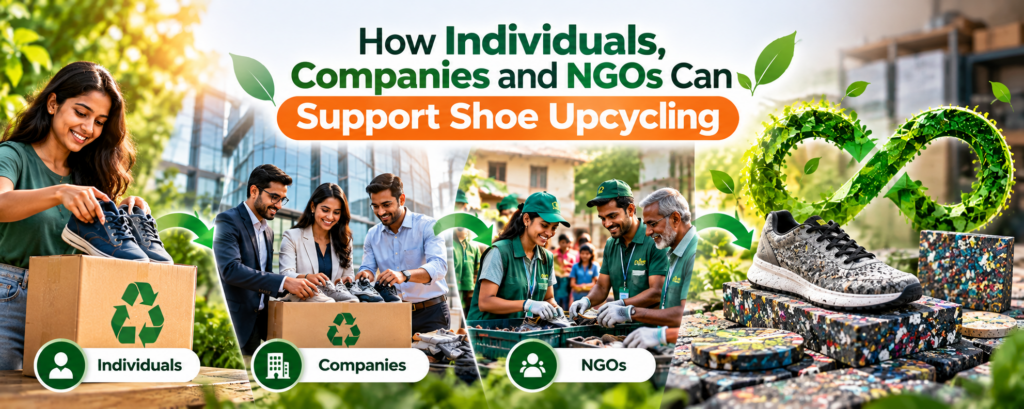
- Individuals: Donate suitable old footwear and apparel, sponsor a pair or kit, or organise a small fundraising activity.
- Companies: Organise collection drives across branches, sponsor products, conduct fundraising, support awareness and participate in co-branding initiatives.
- NGOs and institutions: Facilitate collection, connect programmes with communities, support awareness and assist with data collection.
- Schools and communities: Encourage responsible donation and organise local collection activities.
Each form of participation addresses a different requirement. Together, they can strengthen the overall system.
Conclusion
Shoe upcycling requires more than a collection point. It depends on a network of people and organisations willing to contribute materials, resources, awareness and community support.
Individuals can donate suitable footwear and apparel. Companies can build shoe donation into their CSR programmes through collection drives, sponsorship, fundraising and awareness activities. NGOs and institutions can support collection, community engagement and data-based programme planning.
Greensole Foundation brings these forms of participation together within its wider circular economy and social impact initiatives. By supporting organised collection and responsible upcycling, different stakeholders can contribute to reducing material waste while supporting useful community programmes.
If you have suitable old footwear or apparel to contribute, you can donate through a nearby Greensole collection centre or designated collection channel. Companies, NGOs and institutions can also explore collection drives, sponsorship and other partnership opportunities to support shoe upcycling in a structured and sustainable way.