
What happens when an everyday product reaches the end of its useful life?
For many people, the answer is simple: it goes into the bin. But an old pair of shoes, a discarded banner, or a used material may still contain resources that can be recovered and reused. A circular approach looks beyond disposal and asks a different question: how can we keep these materials useful for longer?
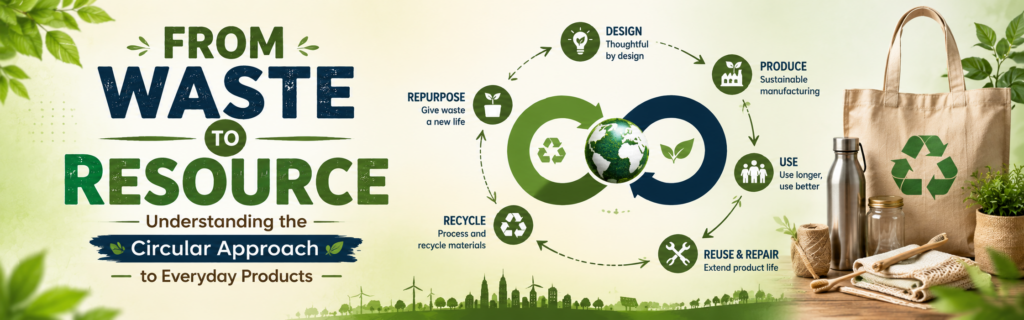
This shift in thinking is at the heart of the circular economy. Instead of following a straight path from production to consumption to disposal, materials are kept in circulation through reuse, repair, refurbishment, and upcycling.
What Is a Circular Approach?
The traditional model of consumption follows a linear pattern. Raw materials are extracted, products are manufactured, consumers use them, and eventually the products are discarded.
A circular approach breaks that pattern.
Products and materials are kept in use for as long as possible. When an item is no longer suitable for its original purpose, it can be repaired, refurbished, reused, or transformed into something new.
This can include:
- Reusing products instead of immediately replacing them
- Repairing items to extend their useful life
- Refurbishing products for continued use
- Recovering valuable materials
- Upcycling discarded items into new products
The objective is simple: make better use of existing resources and reduce unnecessary waste.
Why Everyday Products Need a Circular Model
Many everyday products are not made from a single material. Footwear is a good example.
A typical pair can contain rubber, foam, fabric, synthetic materials, adhesives, and other components. Once discarded, separating these materials can be challenging. As a result, something that still contains useful resources may quickly become waste.
Consider an old pair of shoes.
The sole may have worn down through regular use while the upper part remains in good condition. Instead of treating the entire shoe as unusable, the components that still have value can be recovered and given another purpose.
It is a small change in perspective, but an important one.
From Discarded Shoes to Useful Products
Upcycling gives materials an opportunity to remain useful without necessarily returning them to their original form.
At Greensole Foundation, collected footwear is assessed to understand how it can be used most effectively. Suitable footwear and materials can go through sorting, cleaning, refurbishment, and quality checks before becoming part of a new product.
Some footwear is transformed into comfortable slippers for children in underserved communities.
Other materials can have a different journey altogether.
The focus is on recovering as much usable value as possible rather than treating every discarded pair as waste. In this way, old footwear can continue contributing to the circular economy while creating a practical social benefit.
The Circular Journey of a Product
A circular model can be visualised as a continuous cycle:
Donate → Collect → Sort → Refurbish & Upcycle → Check → Reach Communities
Every stage serves a purpose.
Collection brings discarded materials back into the system. Sorting helps identify what can be reused. Suitable items can then be refurbished, while other materials may be transformed into different products.
The journey does not end at production.
When the resulting products reach communities that need them, the material creates social value as well.
Circularity Goes Beyond Shoes
The circular approach does not stop with footwear. Other materials that are commonly discarded can also be redirected towards useful applications.
One example is flex waste, which is often replaced after serving a short-term advertising purpose. Through the Flex to Bag initiative, discarded flex is repurposed into school bags for children in rural schools.
A material that might otherwise have been thrown away is given a longer and more purposeful life.
The idea is simple: extend the life of materials by finding a new use for them.
This shows how circular thinking can create opportunities beyond conventional recycling.
Environmental Benefits of Keeping Materials in Use
A circular approach can help reduce the environmental pressure associated with producing and disposing of everyday products.
When existing materials are recovered, there may be less dependence on virgin resources for replacement products. Reuse and upcycling can also help divert materials away from landfill.
Some potential benefits include:
- Reduced waste generation
- Better utilisation of existing materials
- Lower demand for virgin resources
- Extended product lifecycles
- Reduced pressure on landfill systems
- Greater awareness of responsible consumption
The real value comes when these practices move beyond individual actions and become part of wider systems.
Creating Social Value Alongside Environmental Impact
Circularity is not only about what happens to materials.
People are an equally important part of the process.
Sorting, cleaning, refurbishing, stitching, assembling, and quality checking all require practical skills. When these activities are organised within communities, they can create opportunities for employment, training, and long-term livelihood development.
Greensole Foundation supports skill-building initiatives that help individuals learn the processes involved in refurbishment, material recovery, and product creation. By combining sustainability with skill development, the organisation creates opportunities for people to participate in a circular economy while contributing to meaningful environmental and social outcomes.
This creates a wider impact.
Discarded materials are redirected from waste streams, while individuals gain practical experience and skills that can support future opportunities and community development.
From Waste Management to Resource Management
The circular economy changes how we define waste.
Instead of viewing a discarded product only as something that needs to be removed, it can be considered a potential source of materials. That shift encourages organisations, businesses, and individuals to think about what happens before an item reaches the landfill.
- Can it be repaired?
- Can someone else use it?
- Can its materials be recovered?
- Can it become something completely different?
These questions open the door to more responsible ways of managing everyday products.
How Individuals Can Support a Circular Economy
Circularity is not something that only businesses or environmental organisations can practise.
Individuals can contribute through everyday decisions. Donate usable footwear rather than throwing it away. Repair items where possible. Choose products designed for longer use. Participate in local collection drives and support organisations working towards responsible reuse and recycling.
Businesses can contribute too.
CSR partnerships, employee collection drives, and community initiatives can help bring larger quantities of materials back into productive use.
Every action adds to the system.
Building a More Circular Future
Moving towards a circular economy requires a change in mindset as much as a change in process.
A product does not automatically lose all its value when its original purpose ends. Sometimes, only one component is damaged. Sometimes, the material simply needs a new application.
An old shoe can become a useful slipper. Discarded flex can become a school bag. Materials that might have ended up as waste can continue serving communities in new ways.
That is the essence of moving from waste to resource.
Conclusion
The circular approach to everyday products is about keeping materials useful for longer and finding better alternatives to the traditional throwaway model. Through collection, reuse, refurbishment, and upcycling, products can take on new purposes instead of immediately becoming waste.
Greensole Foundation demonstrates how this approach can connect environmental responsibility with social impact. Its work with discarded footwear, flex materials, and community skill development shows that circularity can benefit both resources and people.
The next time an everyday product reaches the end of its original use, there is another question worth asking:
Is it really a waste, or could it become a resource for something new?