
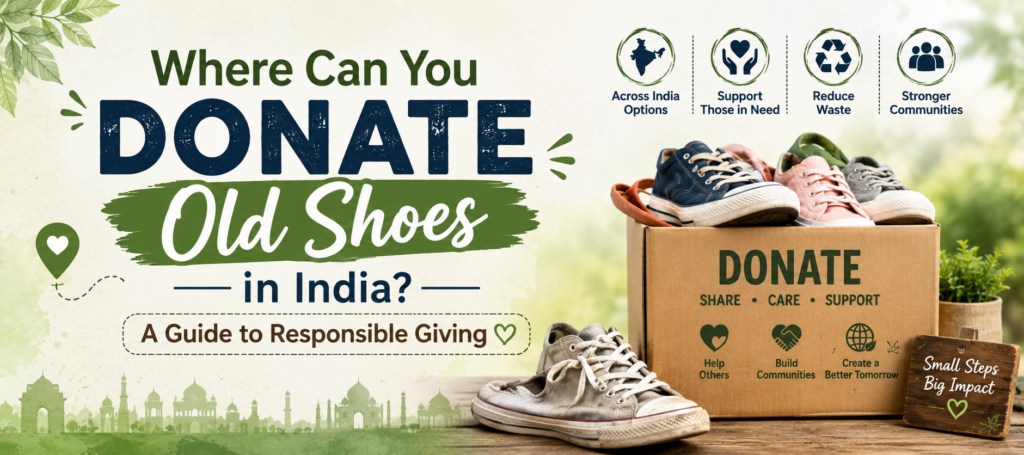
Old shoes often end up in cupboards, waste bins, or landfills simply because they are no longer comfortable or suitable for regular use. But before throwing them away, there is another option: donate old shoes and give them a second purpose.
Across India, organisations are working to divert usable footwear from waste streams and turn it into something meaningful for communities in need. One such initiative is Greensole Foundation, which upcycles discarded footwear into comfortable slippers for children while also working with other discarded materials to create useful products such as bags and mats.
So, where can you donate old shoes in India, and what happens after you donate them?
Why Donate Old Shoes Instead of Throwing Them Away?
A pair of shoes may look unusable simply because the sole has worn out. However, the rest of the footwear can often still contain materials that have functional value.
Most footwear combines materials such as rubber, fabric, foam, synthetic layers, and adhesives. Once discarded, separating these materials through conventional waste systems can be difficult. Donation and upcycling provide another route by allowing suitable footwear to be assessed, refurbished, or repurposed.
The impact goes beyond waste reduction. A donated pair can become part of a larger cycle that connects environmental responsibility with social support.
Where Can You Donate Old Shoes in India?
There are several ways to donate used footwear responsibly.
1. Donate Through Shoe Collection Centres
Greensole Foundation currently has collection centres in Mumbai, Delhi, Pune, Gujarat, Bangalore, Chennai, Rajasthan, Hyderabad, Noamundi, and Kolkata. Donors can choose the nearest collection point and contribute their used footwear through an organised collection network.
This is particularly useful when you have a few pairs at home and want to ensure they enter an organised upcycling programme rather than the waste stream.
2. Courier Your Old Shoes
If there is no convenient collection centre nearby, footwear can also be couriered to Greensole’s designated collection facility. The organisation specifically requests that donors send shoes to the collection address rather than its current office address.
Before sending your shoes, check the latest donation instructions on the organisation’s website, as collection locations and accepted footwear categories can change.
3. Organise a Shoe Donation Drive
You do not have to donate alone.
Schools, housing societies, clubs, workplaces, and community groups can organise collection drives and gather footwear from multiple households. Greensole Foundation encourages individuals to organise such drives in their societies, schools, clubs, and local communities.
A small local drive can therefore turn individual donations into a larger community effort.
4. Companies Can Support Through CSR
Businesses can take the initiative further by combining footwear collection with corporate social responsibility programmes.
Companies can organise discarded footwear collection drives and support the refurbishment and distribution of footwear to children in need. Greensole also offers employee contribution programmes and skill-development opportunities for corporate partners.
This creates a practical connection between CSR, waste management, employee participation, and community development.
What Happens After You Donate Your Shoes?
Donation is only the beginning.
At Greensole Foundation, collected footwear enters a structured upcycling process. The organisation’s model includes collection, processing, refurbishment, and distribution, with the aim of converting discarded materials into useful products.
The process broadly involves:
Collection → Sorting → Assessment → Cleaning & Refurbishment → Quality Checking → Distribution
Each pair is assessed to determine how it can be used most effectively. Footwear that can be refurbished is transformed into comfortable slippers, while other materials can be recovered and used in different applications.
This approach allows old footwear to remain within the resource cycle for longer instead of immediately becoming waste.
From Old Shoes to Footwear for Children
The final destination is an important part of responsible giving.
Greensole works with government and low-income schools, orphanages, child shelters, and rural and tribal communities to distribute upcycled kits. Its 2024–25 annual report states that distribution drives are conducted with local partners, education departments, and CSR sponsors, with beneficiary identification and documentation forming part of the process.
So, the journey does not simply end with refurbishment.
A donated pair can move from someone’s home to a collection centre, through processing and quality checks, and eventually become part of a distribution programme designed around the needs of children and communities.
What Kind of Shoes Can You Donate?
Not every type of footwear is accepted.
According to Greensole Foundation’s current donation guidelines, footwear with heels, sports stud shoes, and footwear for very young children is not accepted. Donors are advised to pair and tie shoes together before bringing or sending them. Individuals, schools, communities, and corporate partners can also support the initiative through organised collection drives and footwear donation programmes.
Because accepted categories and collection instructions can be updated, it is best to check the latest guidelines before packing your donation.
Donors are encouraged to follow the latest collection instructions provided by Greensole Foundation and ensure footwear is paired, securely packed, and suitable for collection. Individuals, communities, and corporate partners can also support footwear donation initiatives through organised collection drives.
A Simple Way to Prepare Your Donation
Before sending your shoes:
- Pair and tie the shoes together.
- Keep footwear clean and reasonably packed.
- Separate shoes from clothes if donating both.
- Pack them securely in a carton or suitable package.
- Check the current accepted-footwear guidelines.
- Use an official collection centre or designated donation address.
These small steps make the collection and processing process easier.
Your Old Shoes Can Create More Than One Impact
The value of a donation is not limited to the person who eventually receives the refurbished footwear.
Keeping materials in use can help reduce waste. At the same time, the refurbishment process creates opportunities for people to develop practical skills and participate in sustainable production.
Greensole’s model also includes skill development. Its first skill centre was established in 2018 in collaboration with Tata Steel and Lions Club Noamundi, where underprivileged people are trained in machinery operation and the refurbishment process.
The organisation has also expanded its approach beyond footwear. In collaboration with DBS Bank, its Flex to Bag initiative began upcycling discarded flex material into bags for children in rural schools.
That is what makes responsible donation different from simply getting rid of something you no longer need.
What If You Do Not Have Shoes to Donate?
Individuals, communities, and corporate organisations can support footwear donation initiatives in several ways. Apart from donating used footwear, supporters can participate in collection drives, sponsor distribution programmes, contribute through employee engagement initiatives, or collaborate on community outreach activities that help extend the impact of responsible giving.
Individuals can sponsor footwear for children in need, while communities can organise fundraising or crowdfunding campaigns. Greensole also provides options for individuals to sponsor back-to-school kits containing slippers, bags, and mats.
Companies can participate through CSR funding, employee contribution programmes, collection drives, or skill-development initiatives.
In other words, responsible giving does not always have to mean giving away a physical pair of shoes.
Give Your Old Shoes a Second Purpose
The next time you find an old pair sitting unused at home, pause before putting it in the bin.
Ask a simpler question: could someone else benefit from it?
Through organised collection and upcycling initiatives, old footwear can be diverted from the conventional waste stream and transformed into useful products for children and communities. Greensole Foundation’s work demonstrates how a discarded material can become part of a wider circular model that combines environmental sustainability, social impact, and livelihood creation.
One pair may seem small.
But when individuals, schools, communities, and companies participate together, those individual contributions can become a much larger movement.
Conclusion
Knowing where to donate old shoes in India is the first step towards making footwear disposal more responsible. Instead of sending unwanted shoes straight to the bin, individuals can use collection centres, courier options, community drives, or organised donation programmes to give them another chance.
At Greensole Foundation, discarded footwear is collected, assessed, refurbished or repurposed, and ultimately connected with communities that can benefit from the resulting products. The model brings together waste reduction, upcycling, social welfare, and livelihood opportunities.
So, the next time an old pair of shoes seems ready for the bin, consider donating it instead. Its journey may not be over yet.