
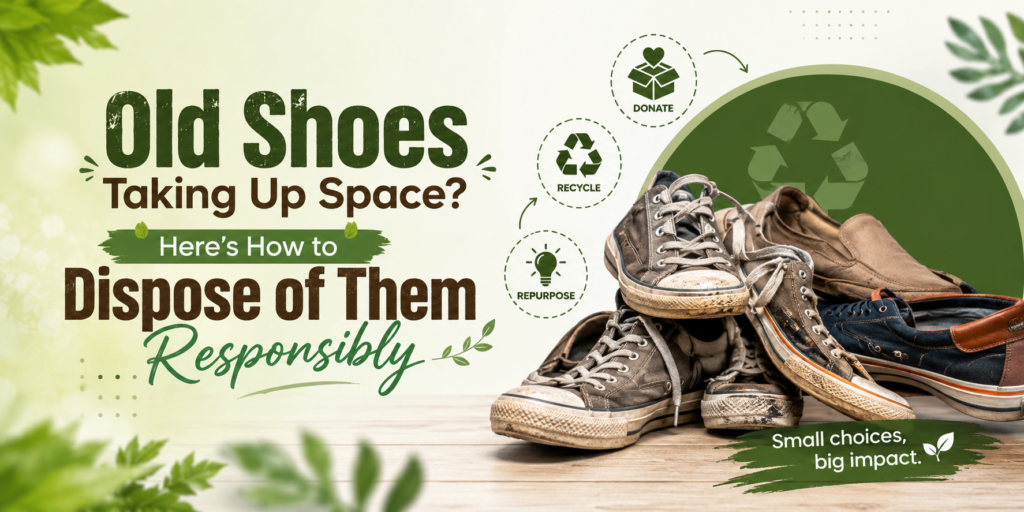
Old shoes have a way of collecting in corners. A pair that no longer fits, another with worn-out soles, and a few that have simply stopped being used can quickly turn into a pile of footwear with no clear purpose.
Throwing them away may seem like the easiest solution. But it is not always the most responsible one.
Many shoes contain materials such as rubber, foam, fabric, synthetic components, and adhesives that are difficult to separate and process through conventional waste systems. At the same time, a shoe may look unusable while still containing parts that can be recovered and given another purpose.
So, what should you do with old shoes?
The answer depends on their condition. Some can be donated for reuse, while others can enter an upcycling process where useful materials are recovered and transformed into something new. This is where responsible footwear disposal can become part of a larger circular approach.
Why You Should Think Twice Before Throwing Away Old Shoes
A worn-out shoe is not necessarily a completely useless shoe.
In many cases, the sole is the first part to deteriorate through regular use, while the upper portion remains in good condition. When the entire pair is thrown away, materials that still have functional value are lost along with it.
This creates two problems. Usable resources leave the production cycle, while discarded footwear adds to the growing volume of waste that needs to be managed.
Responsible disposal changes that equation.
Instead of asking only whether a shoe can still be worn in its current form, it is worth asking what parts of it can still be used.
What Can You Do With Old Shoes?
There are several responsible options depending on the condition of the footwear.
1. Donate Shoes That Can Still Be Used
If your footwear is in a condition where someone else can use it, donation is one of the simplest options. However, organisations may have specific requirements about the types of footwear they accept.
Donation centres can then determine whether a pair is suitable for refurbishment, reuse, or material recovery.
2. Organise a Collection Drive
You do not have to wait until you have a large number of shoes at home. Schools, offices, housing societies, clubs, and community groups can organise collection drives and encourage people to contribute their unused footwear.
A small collection point can gradually bring together dozens or hundreds of pairs.
3. Choose Upcycling When Reuse Is Not Possible
Some footwear may no longer be suitable for direct reuse. That does not automatically make it waste.
Through upcycling, usable components can be recovered and converted into products with a new function. This approach keeps materials in circulation for longer and reduces the need to treat the entire shoe as disposable.
How Greensole Gives Old Shoes a New Purpose
Greensole Foundation has built its work around a simple idea: discarded footwear can still create value.
The organisation collects discarded footwear and apparel through individual donations, collection drives, and partnerships. According to its current collection information, individuals can donate used footwear, organise collection drives in their communities, or send footwear to designated collection centres.
Once the footwear enters the system, it does not simply move from a donation box to another person. It goes through a process designed to recover as much value as possible.
Step 1: Collection
The journey begins when people choose to donate instead of discard.
Footwear can be collected through individuals, schools, societies, corporate offices, and community initiatives. Greensole also has regional collection centres where people can send their footwear.
This first step is important because responsible disposal starts with keeping potentially useful materials out of the general waste stream.
Step 2: Sorting and Assessment
Every pair is different.
The collected footwear is examined to understand its condition and determine the most suitable route. Some pairs may be appropriate for refurbishment, while others contain components that can be recovered for another application.
The focus is not simply on the shoe as a whole. It is on identifying what still has value.
Step 3: Refurbishment and Upcycling
Suitable footwear is refurbished and transformed into comfortable slippers. Greensole’s current model also involves upcycling discarded clothes and other materials into bags and mats. Its annual report describes the production process as combining material recovery with quality, hygiene, safety, and livelihood creation.
This is where an old item moves from being considered waste to becoming a useful resource.
The approach also extends beyond footwear. Greensole’s Flex to Bag initiative, developed with DBS Bank, converts discarded flex material into school bags for children in rural schools.
Step 4: Creating Opportunities Through the Process
Responsible disposal can create social value too.
Upcycling is a labour-intensive activity that involves people in sorting, refurbishment, production, quality checks, and related work. Greensole has also developed skill-building initiatives as part of this model.
In 2018, its first Skill Centre was established in collaboration with Tata Steel and Lions Club Noamundi. The centre trains and employs underprivileged people in machinery operation and the refurbishment process. Greensole says the centre currently supports six families and provides training opportunities for more than 100 people each year.
So the journey of an old shoe does not stop with waste reduction. It can also contribute to skills, livelihoods, and community development.
Step 5: Turning Recovered Materials Into Useful Products
Once the refurbishment and production stages are complete, the resulting products are prepared for distribution.
Greensole’s model focuses on products such as slippers, school bags, and mats for children in need. Its annual report states that distribution takes place through government and low-income schools, orphanages and child shelters, and rural and tribal communities. The organisation also works with local partners, education departments, and CSR sponsors to identify beneficiaries and conduct distribution drives.
This gives the original donation a much longer story.
An old pair of shoes can become part of a product that supports a child’s everyday life.
How This Approach Helps the Environment
Keeping old footwear in circulation has environmental value because it reduces the need to treat every discarded item as waste.
Greensole states that it uses around 80 to 90 percent of old footwear and clothes, helping keep these materials away from landfills. Its current website also reports more than 4,374 tonnes of CO₂ emissions reduced through its work.
The environmental benefits of this approach include:
- Reducing the amount of footwear sent to landfill
- Extending the useful life of existing materials
- Reducing reliance on virgin resources
- Supporting reuse and upcycling
- Encouraging more responsible consumption habits
The exact environmental benefit of any individual pair can vary, but collectively, keeping materials in use can make a meaningful difference.
How You Can Dispose of Your Old Shoes Responsibly
The next time you find an unused pair at home, do not immediately put it in the bin.
First, check its condition. If it can still be donated, consider sending it to an organisation that accepts used footwear. You can also encourage your school, workplace, housing society, or community to organise a collection drive.
For Greensole, individuals can donate old footwear or organise collection drives in their societies, schools, clubs, and local communities. The organisation also provides information about regional collection centres for donations.
Businesses can take this further by supporting footwear collection and refurbishment through CSR partnerships. Corporate programmes can include donation drives, employee contributions, sponsorship of refurbished footwear, or support for skill development initiatives.
A responsible choice does not have to be complicated.
It can start with one pair.
Conclusion
Old shoes taking up space at home do not necessarily belong in the bin. Before throwing them away, consider whether they can be donated, collected, refurbished, or upcycled.
Greensole Foundation demonstrates how this simple shift in thinking can create a larger chain of impact. Discarded footwear is collected, assessed, refurbished or repurposed, and eventually transformed into useful products for children and communities. Along the way, the model supports resource recovery, environmental sustainability, skill development, and livelihoods.
The next time you are ready to clear out your shoe rack, think beyond disposal.
One old pair may still have another purpose waiting for it.